

Most SEO audits, on average, are pretty much garbage. They spit out hundreds of random alerts without telling you what’s actually hurting visibility, which issues matter the most or what to fix first.
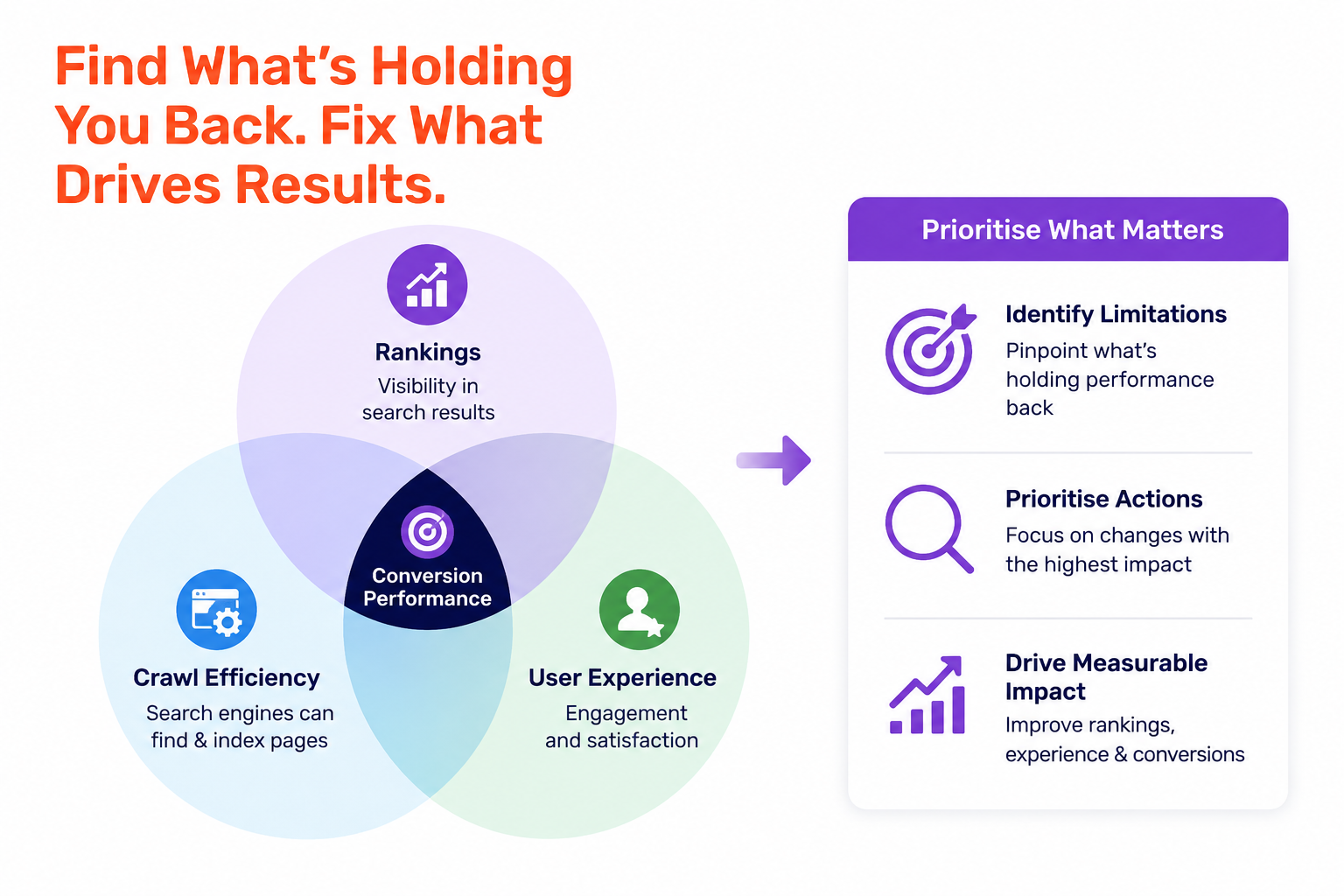
A real SEO audit acts more like a diagnostic.
It finds out where rankings, crawl rate, UX or conversion rate are being constrained.
I prioritize the actions most likely to deliver tangible results based on the research done earlier in the audit process. Without that, an SEO audit is just a PDF that doesn’t move organic traffic.
SEO Audits in an AI-Driven World
That “SEO audit” process goes beyond just Google rankings these days. SEO consultants also now have to do audits for how the site is doing on AI search engines like ChatGPT, Google AI Overviews, Claude, Gemini and Perplexity. In practice, that includes auditing:
- Technical crawlability
- Internal architecture
- Search intent alignment
- Semantic clarity
- Entity relationships
- Content usefulness
- Answer extraction readiness
When I do an audit, I focus on high impact visibility issues across technical SEO, content quality, internal linking and AI search visibility.
The goal is to create an SEO plan that is usable for anyone, rather than a series of generic exports with hundreds of disconnected warnings.
| Audit Area | What It Checks |
|---|---|
| Technical SEO | Crawling, indexing, rendering and site health |
| Content Quality | Search intent, topical depth and usefulness |
| Internal Linking | Authority flow and page relationships |
| Performance | Core Web Vitals and user experience issues |
| Schema and Entities | Structured data and semantic clarity |
| AI Visibility | Answer extraction and citation readiness |
| Competitor Benchmarking | Gaps against websites already ranking |
The goal is not simply finding problems. The goal is understanding what is limiting visibility, how severe the issue is and what should be prioritised first.
What a Professional SEO Audit Actually Reveals
Many businesses assume poor rankings are caused by “not enough SEO”.
In reality, audits often uncover operational problems inside the website itself.
A business publishes content consistently, but key pages are accidentally blocked from indexing.
A service page targets the right keyword, but sits four clicks deep with almost no internal links pointing to it.
A website loads well on desktop, but fails Core Web Vitals on mobile because of oversized scripts and unstable layouts.
A company invests heavily in content production, but every article targets the same narrow keyword variation and fails to build broader topical authority.
These are the kinds of issues that quietly suppress visibility for months or years.
| Symptom | Possible Root Cause |
|---|---|
| Rankings dropped | Indexing conflicts |
| Pages are not ranking | Weak internal architecture |
| Low conversions | Search intent mismatch |
| Poor AI visibility | Weak semantic structure |
| Traffic has plateaued | Topical gaps or outdated content |
The important distinction is that rankings problems are often symptoms rather than root causes.
A proper audit focuses on identifying the underlying structural, technical or content-related limitations creating those symptoms.
How We Perform SEO Audits
Professional SEO audits should follow a structured workflow rather than a single software export.
Our audit process typically follows five stages designed to progressively identify technical, structural, content and visibility limitations.
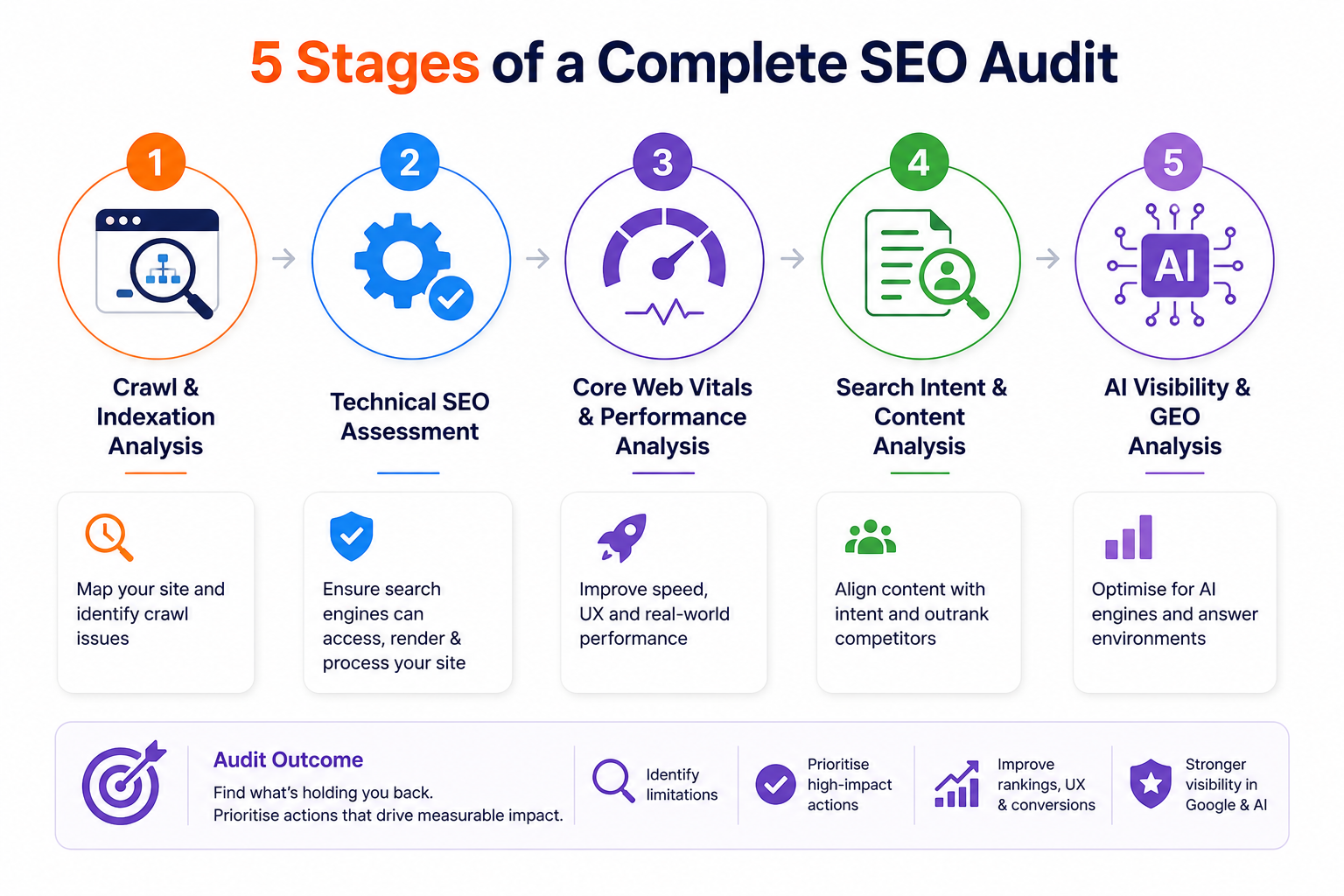
Stage 1: Crawl and Indexation Analysis
The first step is building a complete map of the website.
This is typically performed using platforms such as Screaming Frog, Sitebulb, Ahrefs and Semrush.
The crawl extracts information including:
- URLs
- Status codes
- Canonical tags
- Metadata
- Internal links
- Heading structures
- Schema markup
- Indexability signals
At this stage, the goal is not rankings analysis yet. The goal is understanding how the site is structured and how search engines are likely interpreting it.
| Common Crawl Finding | Why It Matters |
|---|---|
| Orphan pages | Pages struggle to receive internal authority |
| Broken internal links | Creates poor UX and wastes crawl equity |
| Redirect chains | Slows crawling and weakens signals |
| Duplicate canonicals | Creates indexing confusion |
| Noindex conflicts | Important pages may disappear from search |
A strong audit does not simply list these findings. It explains how they affect visibility and which issues are materially suppressing performance.
Stage 2: Technical SEO Assessment
This stage evaluates whether search engines can properly access, render and process the website.
Technical SEO analysis commonly includes:
- XML sitemap validation
- robots.txt analysis
- Canonicalisation
- Pagination handling
- Mobile rendering
- JavaScript rendering
- Core Web Vitals
- Structured data validation
A website can appear visually fine while still having major technical SEO issues underneath.
Example technical problems include:
- JavaScript-heavy pages failing to render correctly
- Faceted navigation creating crawl traps
- Parameter URLs generating duplicate content
- Slow server response times reducing crawl efficiency
- Incorrect canonical tags consolidating pages unintentionally
Technical SEO becomes particularly important on large websites where crawl inefficiencies compound across thousands of URLs.
Stage 3: Core Web Vitals and Performance Analysis
Performance analysis is now a core part of SEO auditing.
Google’s Core Web Vitals framework measures real-world user experience using metrics such as Largest Contentful Paint, Interaction to Next Paint and Cumulative Layout Shift.
Many websites fail these metrics because of:
- Oversized images
- Render-blocking assets
- Excessive JavaScript
- Poorly optimised themes
- Third-party tracking scripts
| Step | Performance Audit Action |
|---|---|
| 1 | Pull Lighthouse and CrUX data |
| 2 | Segment by device type |
| 3 | Analyse high-traffic templates |
| 4 | Identify bottlenecks |
| 5 | Prioritise pages by visibility value |
A common mistake is trying to optimise every page equally.
In practice, audits usually prioritise high-value commercial pages, key templates and URLs already ranking near page one because small improvements there often produce disproportionately large visibility gains.
Stage 4: Search Intent and Content Analysis
This is where audits become genuinely strategic.
The goal is not simply checking keywords.
The real question is whether a page genuinely deserves to rank for the query it targets.
That requires analysing:
- Search intent alignment
- Topical depth
- Information usefulness
- Entity coverage
- Formatting and readability
- Competitor comparisons
- Commercial alignment
| Content Problem | What It Usually Means |
|---|---|
| Thin service page | The page lacks operational detail |
| Traffic but low leads | The page attracts the wrong intent |
| Generic AI-style content | The content lacks specificity and experience |
| Declining rankings | Competitors now cover the topic better |
| Poor engagement | The page may be difficult to scan or repetitive |
One pattern becoming increasingly common is websites publishing large volumes of generic content that technically targets keywords but provides very little original operational insight.
Those pages often struggle in both traditional rankings and AI-generated search environments because they lack specificity, examples and semantic depth.
Stage 5: AI Visibility and GEO Analysis
Traditional SEO audits focused primarily on Google rankings.
Modern audits increasingly assess how content performs inside AI-driven environments such as ChatGPT, Gemini, Claude, Perplexity and Grok.
This area is often referred to as Answer Engine Optimisation (AEO) or Generative Engine Optimisation (GEO).
| GEO Audit Area | Purpose |
|---|---|
| Schema markup | Improves machine understanding |
| FAQ formatting | Supports answer extraction |
| Entity consistency | Clarifies topical relationships |
| Author attribution | Strengthens trust signals |
| Semantic structure | Improves AI readability |
| llms.txt | Supports AI crawler guidance |
Example GEO findings may include:
- Inconsistent entity references
- Weak semantic hierarchy
- Missing FAQ schema
- Unclear authorship
- Poor answer formatting
- Fragmented topic clusters
A surprising amount of AI visibility comes down to structure and clarity rather than content volume alone.
What Our SEO Audit Deliverables Include
A useful SEO audit should not feel like a raw software export.
It should provide a clear explanation of the biggest visibility blockers, estimated impact areas and implementation priorities.
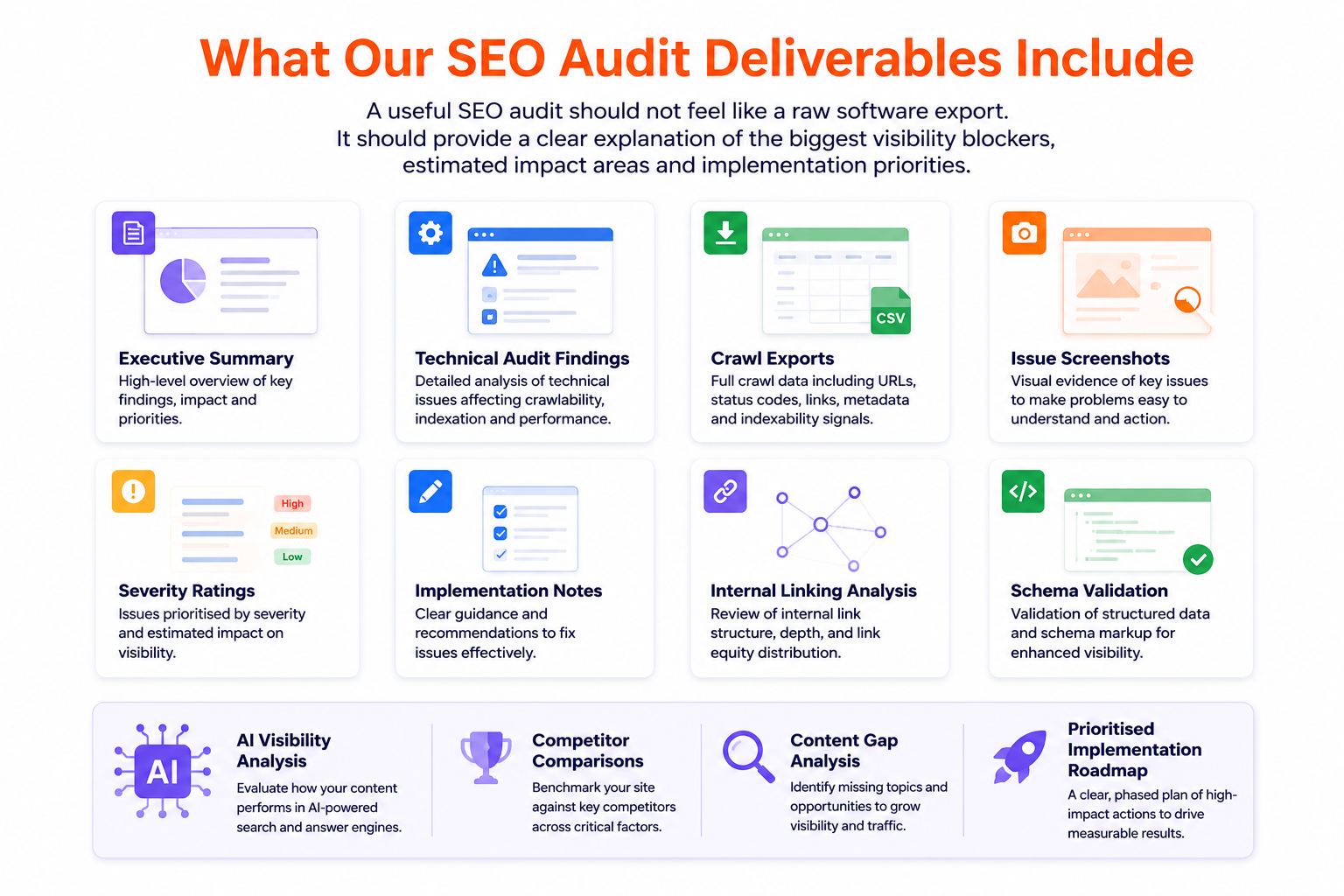
Typical Deliverables Include
- Executive summary
- Technical audit findings
- Crawl exports
- Issue screenshots
- Severity ratings
- Implementation notes
- Internal linking analysis
- Schema validation reports
- AI visibility analysis
- Competitor comparisons
- Content gap analysis
- Prioritised implementation roadmap
The most valuable audits are usually the ones that simplify complexity rather than overwhelm stakeholders with technical jargon.
Example SEO Audit Recommendations
Recommendation quality is often what separates strategic audits from generic scanner exports.
| Finding | Impact | Recommendation |
|---|---|---|
| Important pages missing from XML sitemap | Crawl discovery suppression | Rebuild sitemap using canonical 200-indexable URLs only |
| Thin service pages | Weak commercial relevance | Expand entity coverage, FAQs and implementation examples |
| Weak internal architecture | Poor authority distribution | Add contextual links from supporting informational pages |
| Missing semantic structure | Reduced AI extraction visibility | Improve FAQ formatting and schema consistency |
| Large redirect chains | Signal dilution and crawl inefficiency | Update internal links to point directly to final destinations |
Good recommendations connect technical findings back to business impact rather than treating SEO as an isolated checklist.
How We Prioritise SEO Audit Findings
Not every issue should be fixed immediately.
A strong audit prioritises actions based on:
- Visibility impact
- Implementation difficulty
- Commercial importance
- Traffic influence
- Crawl and indexing severity
| Priority | Impact | Examples |
|---|---|---|
| Critical | Prevents indexing or visibility | Noindex errors, robots blocking, broken canonicals |
| High | Major ranking or UX impact | Slow templates, redirect chains, duplicate pages |
| Medium | Optimisation opportunity | Metadata improvements, schema expansion |
| Low | Minor refinement | Formatting improvements, secondary metadata |
This prioritisation process matters because many websites technically contain hundreds of issues, but only a smaller percentage materially affect visibility or revenue.
SEO Audit vs Automated Audit Tools
Automated SEO tools are useful for identifying patterns and collecting data.
They are not a replacement for strategic analysis.
Most automated audit exports struggle to answer questions like:
- Which issues are actually suppressing rankings?
- Which pages matter commercially?
- Which problems are causing conversion friction?
- Which fixes should be prioritised first?
- Why are competitors outperforming the site?
That distinction matters because visibility problems are often contextual rather than purely technical.
For example, a page may technically satisfy SEO best practices but still fail because it does not align with search intent or because competitors cover the topic more comprehensively.
Similarly, AI visibility analysis often requires semantic interpretation that cannot be fully automated through standard SEO scanners.
focus on clarity and prioritisation rather than overwhelming clients with raw exports.
Common SEO Problems Found During Audits
Across most audits, the same patterns appear repeatedly.
Technical Problems
- Broken internal links
- Orphan pages
- Crawl traps
- Duplicate canonicals
- Incorrect redirects
Content Problems
- Thin pages
- Search intent mismatch
- Outdated statistics
- Repetitive AI-style copy
- Weak topic coverage
Structural Problems
- Poor internal linking
- Disconnected topic clusters
- Buried commercial pages
- Inconsistent anchor text
Performance Problems
- Slow-loading templates
- Bloated JavaScript
- Unstable mobile layouts
- Excessive third-party scripts
The important part is not the existence of these issues. It is understanding which ones are materially suppressing visibility.
How Often Should SEO Audits Be Performed?
Audit frequency depends largely on how quickly the website changes.
| Website Type | Recommended Audit Frequency |
|---|---|
| Brochure / Small Business websites | Quarterly |
| High-growth content sites | Monthly monitoring plus quarterly audits |
| Ecommerce websites | Continuous monitoring |
| Large enterprise sites | Ongoing technical auditing |
Audits become especially important after:
- Website migrations
- CMS changes
- Template redesigns
- Large content uploads
- Major structural updates
Frequently Asked Questions
What does an SEO audit include?
An SEO audit typically includes technical analysis, crawl assessment, indexing reviews, content evaluation, internal linking analysis, performance testing, schema validation and competitor comparisons.
How long does an SEO audit take?
Smaller websites may take several days while larger enterprise websites can require multiple weeks depending on complexity and URL volume.
What tools are used during SEO audits?
Common tools include Screaming Frog, Sitebulb, Ahrefs, Semrush, Google Search Console, PageSpeed Insights and Lighthouse.
Are automated SEO audits accurate?
Automated tools are useful for data collection but often lack prioritisation, business context and strategic interpretation.
What is an AI SEO audit?
An AI SEO audit evaluates how well content performs in AI-generated search environments such as ChatGPT, Gemini and Google AI Overviews.
What is GEO auditing?
Generative Engine Optimisation auditing assesses semantic clarity, answer extraction readiness, structured data and AI visibility signals.
How often should SEO audits be performed?
Most websites benefit from quarterly audits, while large or fast-changing websites often require ongoing monitoring.
Final Thoughts
The websites performing best today are rarely the ones publishing the most content.
They are usually the ones with cleaner technical foundations, stronger internal architecture, clearer semantic structure and more useful information.
A modern SEO audit helps identify where visibility is being lost, where operational inefficiencies exist and which changes are most likely to create measurable growth across both traditional search engines and AI-driven search environments.